

Shakespeare Was an Asshole
On Hamnet, the myth of the tortured genius, and the people who stay

If you have ever dated someone who responded to emotional crisis by becoming “very focused on their work” (that kind of person who discovers a sacred professional commitment the exact moment real emotional presence is required), you already understand the central conflict of Hamnet. The film, directed by Chloé Zhao, is now on VOD and very much in the middle of the awards conversation ahead of the Academy Awards on March 15. Critics have called it “transcendent.” They have cried, publicly and at length, and then written reviews reassuring us that art saves everything, redeems everything, transforms everything.
BULLSHIT.
Shakespeare was an asshole.
In 2026 we’d call this man a deadbeat, a performative male. We’d screenshot his texts and post them on X. His wife’s friends would start a group chat called “Agnes Deserves Better.” Some therapist on Instagram would stitch a clip of him leaving and say this is textbook avoidant attachment and get forty thousand likes. His name would become a verb. “Girl, he’s totally Will-ing you.”
But give this man a quill and a theater in 1596 and suddenly he’s William Shakespeare, greatest writer who ever lived, and the career he ghosted his grieving wife for produced Hamlet — so now we’re all supposed to say thank you. Come on... 🙄 The fact that flawed people make beautiful things is not a law of nature that we should accept. It’s just a pattern we should understand so we can stop romanticizing it.
Let me make my case. But first — if you haven’t seen Hamnet: go see it, it’s brilliant. I’m not spoiling the plot. I’m just spoiling the lie the critics told you about it. This movie is smarter than its own reviews, and it might be smarter than its own director (mansplaining, I know, bear with me...). I promise you’ll enjoy the movie more, not less, you have my word.
Quick context, because this is a real story and it’s wilder than you think.
Shakespeare had a son named Hamnet. (Yes, like Hamlet. The names were interchangeable in the 1590s. Already weird.) Hamnet died of plague at age eleven in 1596. Four years later, Shakespeare wrote a play about a dead prince and named it after his dead son. His wife Agnes (sometimes called Anne Hathaway, I know, I know) raised their three kids basically alone in Stratford while Will lived his best life in London writing plays and almost certainly sleeping with other people. We know this because he wrote entire sonnets about it. The man journaled his affairs in iambic pentameter.
Zhao takes this story and turns it into something gorgeous.
Paul Mescal plays Will; Jessie Buckley plays Agnes (and she gives the kind of performance where you forget you’re watching acting and start worrying about a woman who’s been dead for four hundred years). They meet. They’re electric. Kids happen. He leaves for London. Their boy dies. He writes a play. She watches it.
Every reviewer cried and reached for the same framework: grief becomes genius, art redeems suffering, creation heals what it touches. But wait — this man literally left his wife alone with a dead child so he could go process his feelings AT WORK! That’s not complicated, right? That’s just abandonment dressed up in genius. The film never once shows Will trying to stay. He doesn’t attempt to grieve with her and fail. He doesn’t sit with her for weeks and realize he can’t do it. He doesn’t agonize over the decision. He just goes.
Here’s the thing the reviews missed, and it’s the best thing in the movie.
Zhao builds Agnes as something almost feral. First shot: she’s curled inside a hollow tree like she grew there. She heals people with herbs. She talks to hawks. At one point she wills her own stillborn baby back to life by refusing to let go. This woman is not a supporting character in her husband’s biopic. She’s a force. On the other side, Will does... words, I guess? He watches things happen and makes copies for strangers.
Now — and this is where I need you to stay with me — Agnes doesn’t choose nature over language. She’s locked out of language. She’s a woman in sixteenth-century England. She can’t write plays. She can’t own a theater. She can’t ride to London and turn her pain into a career. When her son dies, her grief has NOWHERE to go, she can only scream in the garden, in her room, in her nightmares… but the grief stays there in her body, in her house, in her world. Private. Small. Hers alone.
Will gets the most powerful expressive technology on earth: a stage, actors, an audience, and the English language at the peak of its powers. Same devastation. Completely different toolkit.
His grief becomes art. Hers just becomes suffering.
That’s not a personality difference. That’s a system… just replace “theater” with “startup” or “record label” or “director’s chair” and tell me the math has changed. I’ll wait.
And Will doesn’t just leave, let’s be honest.
Agnes gave up her family for him. Raised three kids solo while he chased his career in another city. She was already running a MASSIVE deficit of sacrifice before anything terrible happened. When their son died — when the actual worst thing occurred — Will added to the debt. He didn’t stay. He didn’t try to stay. The film doesn’t give him a single scene where he sits with Agnes and fails. No agonized goodbye. No breakdown. He just packs and goes, bye honey.
Will chose expression over presence. The version of grief that gets a standing ovation over the version that just looks like sitting in a room saying nothing and being there anyway.
No play, no matter how great, is a substitute for a person being present with someone they love in the worst moment of their lives. The fact that he later wrote a great play doesn’t settle that account. You can’t withdraw from the people who depend on you, convert their suffering into professional achievement, and then claim the achievement as repayment. That’s not how human obligation works.
And there’s something fundamentally selfish about the artist’s impulse to turn private pain into public work. Will didn’t write Hamlet for Agnes. He wrote it for himself, for audiences, for posterity. The most intimate loss of her life got metabolized into someone else’s career achievement. She didn’t consent to that. She didn’t even know about it until she walked into the Globe and discovered her grief had been turned into a play without her.
We have so much language for this now that it almost feels polite. Love bombing into discard. Weaponized vulnerability. A man who will cry on a podcast, quote his therapist, and still vanish when real responsibility shows up. He is “doing the work” on himself in a different zip code while you manage the bills, the grief, and the rest of the mess.
Shakespeare is the original “I just need space to figure things out”… except his space produced the most performed play in human history, so we gave him a pass. For four centuries. And counting.
Critics love to say that Hamnet is about how art helps us survive. “We tell stories so that we can survive.” “Art is necessary, like breathing.” That’s a beautiful sentiment. It’s also the kind of thing people write when they want to be a little self-indulgent about their own line of work.
Think about what that reading actually implies. If art truly “healed” Agnes, that would undermine the film’s own feminist argument. It would mean Will’s play fixed what Agnes couldn’t fix herself, that a man’s creative act was the cure for a woman’s embodied suffering. That’s a pretty uncomfortable conclusion for a film that spent its entire runtime insisting on Agnes’s autonomy, right? The play doesn’t heal her. It gives her a container. A frame. A way to look at the thing that’s been destroying her without being annihilated by it. That’s not salvation. That’s oxygen.
Now the ending, and this is where Zhao (brilliant, Oscar-winning, clearly-thought-about-this-for-years Zhao) loses the thread of her own movie.
She spends two hours building Agnes’s world. Making you feel what it’s like to be the one who stays, the one whose grief has no stage and no audience and no applause. And then she resolves the whole thing in Will’s theater. On Will’s terms. Agnes walks into the Globe, watches Hamlet, sees a vision of her dead son, and smiles for the first time since the funeral.
Art wins. Hurrah! The genius was right to leave. Roll credits, pass the tissues, five stars.
And of course Zhao went there. She’s a filmmaker, she IS Will — someone who takes pain and turns it into content for strangers. She literally said it: “There is a tunnel vision when you have immense pain and your art becomes your salvation. I was where the character in Hamnet was.” Of course someone who makes art for a living would tell a story where the artist’s selfish retreat turns out to save everyone. It’s self-serving as hell. It’s the artist’s fantasy about their own necessity.
The truly radical version of this film? Agnes finds peace through her own means. Through the cave, the land, the bees, the children who are still alive. Not through his play, not in his building, not by being his audience. That film would’ve honored the world Zhao spent two hours constructing. But she couldn’t pull the trigger. She’s too honest about her own bias and not honest enough to override it.
OK. Deep breath. I’ve been prosecuting this man for a thousand words, and I owe the movie — and you — some honesty about where my argument gets shaky.
Watch that ending again. Agnes walks in on her own. Nobody drags her. And she doesn’t experience the play the way the audience does. Three hundred strangers cry at a story about a prince. Agnes sees her actual dead son. Those aren’t the same event. The audience gets catharsis. Agnes gets recognition.
Maybe the ending isn’t “Will was right.” Maybe Will built something he didn’t understand, and Agnes — the healer, the seer, the one who talks to hawks — is the only person in that room who knows what it really is. He wrote better than he knew. She sees deeper than he created.
And look, maybe two destroyed people in the same house wouldn’t have saved each other anyway. Maybe they’d just have become two mirrors bouncing the same unbearable thing back and forth until it killed them both.
Maybe Will left because he was broken and writing was his only wrench. That’s limited. That’s insufficient. But it’s not nothing.
Fine. Complicated asshole.
Here’s where I land, and it’s colder than any review I’ve read. The value of what someone creates and the moral quality of how they lived are two separate ledgers. They don’t cancel each other out. They don’t merge. They just sit there, side by side, forever.
John Lennon wrote “Imagine” and was a cruel, absent father to Julian. Miles Davis made Kind of Blue and beat the women he loved. Two of the women closest to Picasso died by suicide; he used their images, their bodies, their emotional lives as raw material for paintings now considered among the greatest of the twentieth century. Caravaggio literally killed a man and painted some of the most empathetic depictions of grief in Western art. Joni Mitchell wrote Blue from the grief of giving up her daughter — and that daughter grew up motherless and is not healed by the album’s existence. We can hold all of this at once. We just usually don’t.
And then there are the people who stayed. Who chose presence over creation. Who held their partners through the worst thing and never wrote a play about it. Nobody knows their names. They did the right thing.
There’s no Grammy for showing up. There’s no Globe Theatre for holding someone’s hand in the dark.
Agnes held her dying son’s body alone. Will was in London. Nobody wrote a review of that.
The myth of the tortured genius doesn’t describe a necessity. It describes a choice we decorated as destiny because the output was impressive.
Lennon could have been present and great. Miles could have been kind and transcendent. Will could have stayed in Stratford for six months, grieved beside his wife, and then written the play. Maybe it would’ve been different. Maybe better. We’ll never know, because they didn’t try.
The question isn’t whether flawed people make great art. They do. The question is whether we keep building a culture that treats that as an acceptable trade-off — or whether we start insisting that greatness and decency are not mutually exclusive, and that the people who stay deserve as much reverence as the people who create. Whether we actually internalize that — whether we stop treating the Wills of the world as heroes and the Agneses as supporting characters — that’s on us.
That’s why I love this movie. Not because it resolves anything; it doesn’t. Two people will walk out of the same theater: one says “art heals” and the other says “he should have stayed home” and both are right and neither has the whole picture. Agnes’s smile at the end isn’t forgiveness. It’s not “you were right to leave.” It’s something harder, I think: a woman discovering that the worst thing her husband did to her produced something that touches the deepest part of her own experience. That’s not resolution. That’s just what being alive actually feels like.
Go see it. Bring someone you’ll fight with after. That’s what it’s for.
WHAT I FOUND
4 things worth your time this week
Ratboys — Singin’ to an Empty Chair (New West Records)
Six albums in, Ratboys have stopped being polite about how good they are. Singin’ to an Empty Chair plays like one long, unflinching conversation with someone who’s already left the room, post-therapy Julia Steiner picking through the wreckage with a clarity that makes the twangy prettiness around her feel almost uncomfortably generous. The eight-minute “Just Want You to Know the Truth” is the kind of song most bands would build an entire career around. Ratboys just let it sit there, monumental and unhurried, then close the whole thing with a quiet declaration of peace.
For fans of: Wednesday, Waxahatchee, Hop Along, Advance Base
File under: Post-therapy Americana that will make you text your ex and then immediately delete the draft
By Storm — My Ghosts Go Ghost (deadAir)
The question was never whether RiTchie and Parker Corey could survive the end of Injury Reserve. The real question was whether they could make something that didn’t sound like a memorial. My Ghosts Go Ghost is the answer, and it’s complicated: nine tracks of fractured, cavernous hip-hop where grief has stopped being the subject and become the weather. RiTchie raps about delivering food between sessions, refuses to cut his locs because his dead friend’s face lives in the mirror, and invites billy woods over to make everything feel more like dread. Their most human record, which given the circumstances is a kind of miracle.
For fans of: Armand Hammer, Moor Mother, Slauson Malone 1, JPEGMAFIA
File under: The most important debut album from a band that’s technically been around for a decade
MØL — DREAMCRUSH (Nuclear Blast)
Blackgaze’s entire pitch has always been “what if extreme metal made you feel good?” and most bands stop right there. Denmark’s MØL, five years removed from Diorama, have pushed past the premise entirely. DREAMCRUSH is the rare record where blast beats and Cocteau Twins shimmer coexist not as novelty but as native language. Kim Song Sternkopf switches between guttural Danish and fragile English croons like a man unsure which tongue carries more weight, and the guitars sound like they were recorded inside a cathedral that’s also, somehow, on fire. Forty-two minutes, no filler, all crush.
For fans of: Deafheaven, Alcest, Nothing, Slowdive-if-Slowdive-got-really-mad
File under: The Viking answer to “what if shoegaze had teeth and a really good dentist”
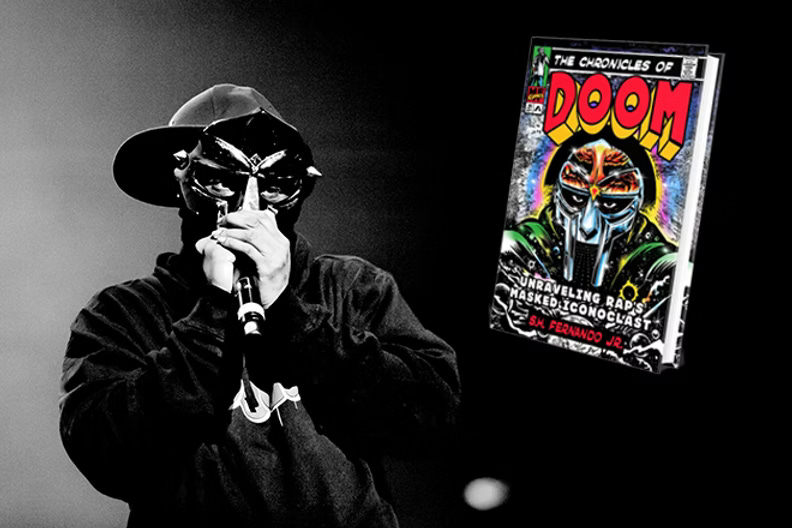
S.H. Fernando Jr. — The Chronicles of DOOM: Unraveling Rap’s Masked Iconoclast (Astra House, 2024)
I’ve just started this and I already know I’m going to love it. S.H. Fernando Jr. — who previously wrote the definitive Wu-Tang biography — has done the same for Daniel Dumile Jr., the man behind MF DOOM’s mask, and the structure alone tells you he understands the assignment: five sections titled The Man, The Myth, The Mask, The Music, and The Legend. Fernando tracks Dumile from Long Beach, New York through KMD, into the wilderness years, onto the stage of his first masked show, and across every alias and collaboration that followed. The track-by-track album breakdowns are meticulous, the exclusive interviews with DOOM’s inner circle are genuinely revealing, and Fernando writes about east coast rap history with the contextual fluency of someone who lived through it at The Source and Rolling Stone. The Guardian called it excellent. Booklist gave it a starred review and paired it with Dan Charnas’s Dilla Time, which is exactly the right shelf. Thom Yorke called DOOM’s wordplay “shocking in its genius.” Tommy Orange said the book reads “as compellingly as the origin stories of the greatest superheroes and supervillains.” It’s the biography your favorite rapper’s favorite rapper deserved.
For fans of: Dilla Time, The Big Payback, Mo’ Meta Blues, Jeff Chang’s Can’t Stop Won’t Stop
File under: ALL CAPS when you spell the man’s name, all pages when you read his life
HI!
This is the first issue of Found Object. Every week I write about something that got the wrong kind of attention or not enough of the right kind. The lead goes deep. The rest goes wide. I care about what happens when the lights go down and the thing on the screen turns out to be about you.
Free. Weekly. If it’s good, tell someone.
— Rodrigo
Culture, surfaced.